
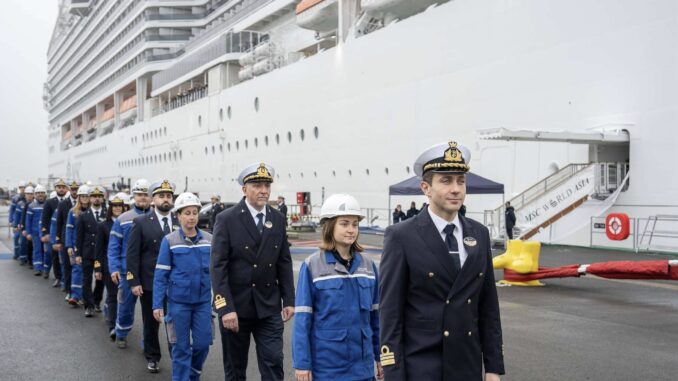
MSC Cruises’ new baby is called World Asia, but she will split her time between the Mediterranean and the Caribbean.
The 5,240-guest new ship was delivered at the end of November in France and will be sailing on seven-night itineraries across the Mediterranean through Summer 2027 before heading to the South Caribbean for the Winter 2027/2028 season.
MSC World Asia is the twentieth ship built by Chantiers de l’Atlantique for the MSC Cruises fleet. Construction brought together more than 500 French suppliers, highlighting the scale and complexity involved.
“Each World Class ship advances innovation, technology and the guest experience, while bringing us closer to our goal of net zero emissions from marine operations by 2050. Among the world’s most energy-efficient cruise ships, MSC World Asia demonstrates our commitment to improving each new ship’s environmental performance and investing in our long-term future,” said Pierfrancesco Vago, Executive Chairman, of MSC Group’s Cruise Division and the delivery.
While she shares the pioneering design and signature features of previous World Class ships, the new build has distinctive features and an identity inspired by the cultures, artistry and landscapes of Asia.
MSC World Asia also builds on the advances in energy performance introduced across the World Class platform. The ship brings together technologies designed to reduce energy demand and improve operational efficiency across hydrodynamics, propulsion, power generation, heat recovery, cooling and water production.
An optimized hull and thruster design improves hydrodynamic efficiency, while an advanced hull coating reduces frictional resistance between the hull and the water.
The vessel is powered by the latest-generation dual-fuel liquefied natural gas engines of different capacities, helping to match power production more closely with operational demand. These engines, including one prototype engine, are also able to significantly reduce methane slip. The dual-fuel configuration provides flexibility for the future use of renewable fuels, including bio-LNG and synthetic LNG, as they become more widely available and commercially viable.
Together, these technologies support MSC Cruises’ Energy Transition Plan and its target of achieving net-zero greenhouse gas emissions from its marine operations by 2050.
A sister ship, MSC World Atlantic will be delivered next October, with a further four World Class ships on order with the shipyard, providing a program of new ship construction through 2031.
Wallace Immen, The Cruisington Times



Be the first to comment