
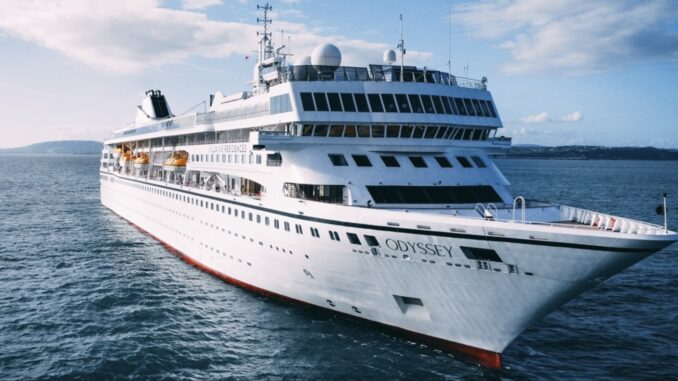
What was sold as the “never-ending cruise” ended in dramatic fashion, with residents told they had just a few hours to pack up and leave their home.
Details are still scarce about why the Villa Vie Odyssey, a residential cruise ship operated by Villa Vie Residences that offered passengers a long-term floating home to travel around the world continuously suddenly went bankrupt.
But it’s a cautionary tale about trusting deals that sound too good to be true.
Villa Vie sold permanent cabins on the 33-year-old ship formerly know as the Braemar at prices ranging from $119,999 to $439,999 along with thousands of dollars in monthly maintenance fees. Buyers were promised an endless cruise, with stops at more than 400 ports of call and a global circumnavigation every three-and-a-half years.
After about two years of sailing, the Odyssey tied up in Sihanoukville, Cambodia and the 230 residents were evicted . Several have taken to social media saying they had sold their homes ashore and are now stranded in Asia.
The company’s founder, Mikael Petterson, told Business Insider that he is now considering bankruptcy. The parent company of Villa Vie Residences is registered in the Marshall Islands and lists Petetrson as executive chairman and Kathy Villalba as CEO.
“Nobody that’s tried residential cruising has succeeded, and we’ve gone further than anyone else,” Petterson told the business site. He said that he believes if it had not been for the conflict in Iran, the company would have been “absolutely fine” and it “would have seen this through.”
In fact in 2025 Villa Vie Residences announced it planned a second residential ship to be called Lumina, which never developed beyond a concept.
However, former residents have been posting on social media that a financial crisis had been developing for months. Some claimed the company had asked residents to help keep the ship sailing with loans that promised interest of up to 20 per cent.
Robert Kwortnik, an associate professor at Cornell University’s SC Johnson College of Business, told Inc. Magazine that “it’s reasonable to claim that the war in Iran negatively affected Villa Vie operations.” However, he said there were likely more fundamental challenges to the business model.
Despite rising fuel costs, cruise line giant Royal Caribbean Group reported $5.59 billion in total revenue in the third quarter. Carnival Corp. reported record revenue of $8.43 billion for the same period. “This performance stands in stark contrast to Villa Vie’s operational shutdown due to financial woes,” Kwortnik said. He noted that large operators can use fuel hedges to cushion themselves against price volatility.
And it’s not true that Villa Vie was the most successful residential ship. The World, a luxury ship whose suites are owned by residents has been sailing since 2002, although at much higher prices. Other residential cruise lines have been floated as ideas, but never actually sailed.
According to Reuters, Villa Vie Odyssey had 203 passengers and 156 crew members aboard when it reached Cambodia. That means the ship whose 480 cabins with space for 930 guests was less than half full, although company founder Petterson claimed it was 85 per cent sold.
The fundamental question, is whether there is a large enough market for residential cruising, Kwortnik notes. “If so, can that market produce the revenue needed to cover high fixed costs and unexpected economic shocks wrought by geopolitical conflicts?”
Don’t commit to emarking on an Odyssey without doing your homework.
Wallace Immen, The Cruisington Times




Be the first to comment